First, Step Up
by Bill McKibben
|
 

|
 |
|
Asking people to make
sacrifices to stop Global Warming is political
suicide, right? Evidently not.

|
|
 |
|
|
|
|
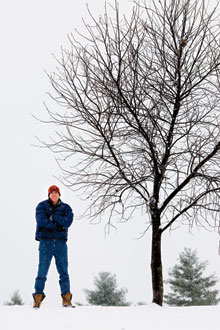
Bill McKibben has
been sounding the alarm on climate
change since his 1989 book,
The End
of Nature. He lives in Ripton,
Vermont, where he teaches, writes, and
works to counter climate change.
Photo
by Channing Johnson for YES! Magazine |
|
|
At any given moment we face as a society an
enormous number of problems: there’s the
mortgage crisis, the health care crisis, the
endless war in Iraq, and on and on. Maybe we’ll
solve some of them, and doubtless new ones will
spring up to take their places. But there’s only
one thing we’re doing that will be easily
visible from the moon. That something is global
warming. Quite literally it’s the biggest
problem humans have ever faced, and while there
are ways to at least start to deal with it, all
of them rest on acknowledging just how large the
challenge really is.
What exactly do I mean by
large? Last fall the scientists who study sea
ice in the Arctic reported that it was melting
even faster than they’d predicted. We blew by
the old record for ice loss in mid-August, and
by the time the long polar night finally
descended, the fabled Northwest Passage was open
for navigation for the first time in recorded
history. That is to say, from outer space the
Earth already looks very different: less white,
more blue.
What do I mean by large? On
the glaciers of Greenland, 10 percent more ice
melted last summer than any year for which we
have records. This is bad news because, unlike
sea ice, Greenland’s vast frozen mass sits above
rock, and when it melts, the oceans
rise—potentially a lot. James Hansen, America’s
foremost climatologist, testified in court last
year that we might see sea level increase as
much as six meters—nearly 20 feet—in the course
of this century. With that, the view from space
looks very different indeed (not to mention the
view from the office buildings of any coastal
city on earth).
What do I mean by large? Already higher heat is
causing drought in arid areas the world over. In
Australia things have gotten so bad that
agricultural output is falling fast in the
continent’s biggest river basin, and the
nation’s prime minister is urging his people to
pray for rain. Aussie native Rupert Murdoch is
so rattled he’s announced plans to make his
NewsCorp empire (think Fox News) carbon neutral.
Australian voters ousted their old government
last fall, largely because of concerns over
climate.
What do I mean by large? If
we’d tried we couldn’t have figured out a more
thorough way to make life miserable for the
world’s poor, who now must deal with the loss of
the one thing they could always take for
granted—the planet’s basic physical stability.
We’ve never figured out as efficient a method
for obliterating other species. We’ve never
figured out another way to so fully degrade the
future for everyone who comes after us.
Or rather, we have figured
out one other change that rises to this scale.
That change is called all-out thermo-nuclear
war, and so far, at least, we’ve decided not to
have one. But we haven’t called off global
warming. Just the opposite: in the 20 years that
we’ve known about this problem, we’ve steadily
burned more coal and gas and oil, and hence
steadily poured more carbon dioxide into the
atmosphere. Instead of a few huge explosions,
we’ve got billions of little ones every minute,
as pistons fire inside engines and boilers burn
coal.
Having put off real change,
we’ve made our job steadily harder. But there
are signs that we’re finally ready to get to
work. Congress is for the first time seriously
considering legislation that would actually
limit U.S. emissions. The bills won’t be signed
by President Bush, and they don’t do everything
that needs doing—but they’re a start.
We need a
movement. We need a political swell larger
than the civil rights movement—as passionate
and as willing to sacrifice. Without it,
we’re not going to best the fossil fuel
companies and the automakers and the rest of
the vested interests that are keeping us
from change.
And the
international community meeting in Bali in
December overcame U.S. resistance and began the
steps toward an international treaty that will
be ready in 2009. The talks are going slowly,
largely because of American intransigence, but
George Bush won’t be president forever, so
there’s at least a chance we’ll re-engage with
the rest of the world.
If we do, there are steps we
can take. Because the problem is so big, and
coming at us so fast, those steps will need to
be large. And even so, they won’t be enough to
stop global warming—at best they will slow it
down and give us some margin. But here’s the
deal:
We need to conserve energy. That’s the cheapest
way to reduce carbon. Screw in the energy-saving
lightbulbs, but that’s
just the start. You have to blow in the new
insulation—blow it in so thick that you can heat
your home with a birthday candle. You have to
plug in the new appliances—not the flat-screen
TV, which uses way more power than the old set,
but the new water-saving front-loading washer.
And once you’ve got it plugged in, turn the dial
so that you’re using cold water. The dryer? You
don’t need a dryer—that’s the sun’s job.
We need to generate the
power we use
cleanly. Wind is the fastest growing source
of electricity generation around the world—but
it needs to grow much faster still. Solar panels
are increasingly common—especially in Japan and
Germany, which are richer in political will than
they are in sunshine. Much of the technology is
now available; we need innovation in financing
and subsidizing more than we do in generating
technology.
We need to change our
habits—really, we need to change our sense of
what we want from the world. Do we want enormous
homes and enormous cars, all to ourselves? If we
do, then we can’t deal with global warming. Do
we want to keep eating food that travels 1,500
miles to reach our lips? Or can we take the bus
or ride a bike to the farmers’ market? Does that
sound romantic to you? Farmers’ markets are the
fastest growing part of the American food
economy; their heaviest users may be
urban-dwelling immigrants, recently enough
arrived from the rest of the world that they can
remember what actual food tastes like. Which
leads to the next necessity:
We need to stop insisting
that we’ve figured out the best way on Earth to
live. For one thing, if it’s wrecking the Earth
then it’s probably not all that great. But even
by measures of life satisfaction and happiness,
the Europeans have us beat—and they manage it on
half the energy use per capita. We need to be
pointing the Indians and the Chinese hard in the
direction of London, not Los Angeles; Barcelona,
not Boston.
Building a Movement
Most of all, we need a movement. We need a
political swell larger than the civil rights
movement—as passionate and as willing to
sacrifice. Without it, we’re not going to best
the fossil fuel companies and the auto-makers
and the rest of the vested interests that are
keeping us from change.
Some of us have spent the
last couple of years trying to build that
movement, and we’ve had some success. With no
money and no organization, seven of us launched
StepItUp in January 2007. Before the year was
out, we’d helped organize 2,000 demonstrations
in all 50 states—and helped take our
once-radical demand for an 80 percent reduction
in U.S. carbon emissions by mid-century into the
halls of power.
We haven’t won yet—but we’re
way beyond what we could have expected when we
began. Last November, House Speaker Nancy Pelosi
stood at a podium in front of 7,000 college
students gathered from around the country at the
University of Maryland and led them in a chant:
“80 percent by 2050.” I’m as cynical as the next
guy, but it feels like our democracy is starting
to work.
It will need to work much
better, though. We’ll need to see a whole new
level of commitment—to nonviolent protest, to
electioneering, to endless lobbying. We’ll have
to be committed to an environmentalism much
broader and more diverse than we’ve
known—younger, browner, and insistent that the
people left out of the last economy won’t be
left out of the new one. And we’ll need to see
it not just here but around the world. Because
they don’t call it global warming for nothing.
If we’re going to have a fighting chance, we’ll
need every nation pitching in—which means, in
turn, that we’ll have to understand where we all
stand right now.
What about China and India?
Here’s the political reality check, just as
sobering as the data about sea ice and drought:
China last year passed the United States as
the biggest emitter of carbon on Earth. Now,
that doesn’t mean the Chinese are as much to
blame as we are—per capita, we pour four times
more CO2 into the atmosphere. And we’ve been
doing it for a
hundred years, which means it will be
decades before they match us as a source of the
problem. But they—and the Indians, and the rest
of the developing world behind them—are growing
so fast that there’s no way to head off this
crisis without their participation. And yet they
don’t want to participate, because they’re using
all that cheap coal not to pimp out an already
lavish lifestyle, but to pull people straight
out of deep poverty.
Which means that if we want
them not to burn their coal, we’re going to need
to help them—we’re going to need to supply the
windmills, efficient boilers, and so on that let
them build decent lives without building
coal-fired power plants.
Which means, in turn, we’re
going to need to be generous, on a scale that
passes even the Marshall Plan that helped
rebuild post-World War II Europe. And it’s not
clear if we’re capable of that any more—so far
our politicians have preferred to scapegoat
China, not come to its aid.
I said at the start that
this was not just another problem on a list of
problems. It’s a whole new lens through which we
look at the world. When we peer through it,
foreign policy looks entirely different: the
threats to our security can be met only by
shipping China technology, not by shipping
missiles to China’s enemies.
When we peer through the
climate lens, our economic life looks completely
changed: we need to forget the endless expansion
now adding to the cloud of carbon and
concentrate on the kind of durability that will
let us last out the troubles headed our way.
Another Way to be Human
Our individual lives look very different through
these glasses too. Less individual, for one
thing. The kind of extreme independence that
derived from cheap fossil fuel—the fact that we
need our neighbors for nothing at all—can’t
last. Either we build real community, of the
kind that lets us embrace mass transit and local
food and co-housing and you name it, or we will
go down clinging to the wreckage of our
privatized society.
Which leaves us with the one
piece of undeniably good news: we were built for
community. Everything we know about human
beings, from the state of our immune systems to
the state of our psyches, testifies to our
desire for real connection of just the kind that
an advanced consumer society makes so difficult.
We need that kind of community to slow down the
environmental changes coming at us, and we need
that kind of community to survive the changes we
can’t prevent. And we need that kind of
community because it’s what makes us fully
human.
This is our final exam, and
so far we’re failing. But we don’t have to put
our pencils down quite yet. We’ll see.
|
Bill
McKibben wrote this article as part of
Stop Global Warming Cold,
the Spring 2008 issue of YES!
Magazine. Bill McKibben is the author of
The End of Nature, Wandering Home, and
Deep Economy, and a founder of
StepItUp, which has recently joined
forces with
1sky. |
 |
|
|
 |
|
|
 YES! Magazine encourages you to make
free use of this article.
YES! Magazine encourages you to make
free use of this article. |
Lea este artículo en español ::
Read this article in Spanish |